
How to wow a GCSE History examiner
To achieve a level six and above in GCSE history, examiners are looking for the ability to consistently explain your ideas. But why stop at a level six or seven, when you can really wow the examiner?
Ellen Longley shares her top strategy!
What are GCSE History examiners looking for?
So, the highest marks in the papers are awarded in the essay-style questions and on these, the top level of the mark scheme asks students to explain two sides of an argument and reach an overall judgement. A good GCSE history essay will follow a similar format: different arguments will be considered, explained and supported with evidence and a final decision will be explained and supported.
Examiners use terms like ‘an overall judgement’, ‘a clinching argument’ or a ‘comparative judgement’ and what they’re looking for is for you to reach a final answer and explain why that side of the argument is stronger than the other.
Developing overall judgements
There’s no one ‘right’ approach to this – whatever structure you prefer can be credited, so long as you demonstrate the right skills. Some students leave their final judgment until their conclusion. This is fine, but make sure that you don’t just summarise what you’ve already said. You need a ‘clinching argument’ – something that you use as a framework for making your overall judgment.
Another way is to weave your overall judgment throughout your answer. Make it clear what your view is in your introduction, use it when discussing both sides of the argument and then clarify it in your conclusion. It’s a more sophisticated method to sustain your judgment throughout your response, but it can be quite difficult and requires good planning to make sure your line of reasoning is consistent, clear and convincing.
Now, to make your answer really stand out, you need to be thinking about using ‘second-order historical concepts’
What are ‘second-order historical concepts’?
Let’s remind ourselves of what these are.
- Cause and consequence
- Change and continuity
- Significance
- Similarity and difference
The key to using these successfully is to work out which is most applicable to the question you’re answering,
Cause and consequence
Argument A is more convincing than B, because A caused B.
For example, in an essay that asks you why health improved in the Nineteenth Century, you might consider factors such as scientific development or the increased public health provisions put in place by the government. You might conclude that scientific development mattered more, because without them, there was no reason for governments to do more and anything they tried was less likely to succeed. To illustrate, the turning point really came with Pasteur’s germ theory. Prior to this scientific development no one understood what caused illness, so any measures to tackle it had limited success. Germ theory informed everything: whether it was cleaning up slum housing or explaining why vaccination worked. Therefore, the scientific development of Germ theory informed every other development, making it the more significant factor in explaining why health improved.
Change and continuity
Argument A is more convincing, because it led to significant change, while B didn’t really change anything.
For example, in an essay that asks why the Soviet Union collapsed, you might consider Soviet economic weaknesses versus the policies of Gorbachev. You might conclude that the Gorbachev’s policies were more important because there had always been economic flaws to the economy of the USSR so this factor had continued, arguably since the 1920s. However, what changed was Gorbachev’s policy of ‘Glasnost’ meaning openness, which meant that people were now more free to discuss and criticise the actions of the Soviet government, meaning that criticism of issues like flaws in the economy now lead to active opposition and the collapse of the government.
‘Turning points’ can be good for this type of evaluation. For example, if you’re explaining why the League of Nations failed, you could explain that the turning point was 1929. Things worked in the 1920s, when nations were willing to try to cooperate, but once the Great Depression hit in 1929 countries looked out for themselves and were less inclined to support the work of an international body such as the League.
Significance
Historical significance can be defined by different criteria. Here we’ll focus on just two: extent of impact and the perspective of different groups.
Extent of impact can be assessed by considering how many people’s lives changed because of a factor. For example:
A was more significant, because it affected the whole country, while B was only really felt in London.
Perspective of different groups can explain how different people felt about a factor. For example, if considering whether the New Deal was a success, you could conclude that white working class men might celebrate the New Deal as it provided jobs and support for them. Women or black people might be more critical of the New Deal as there wasn’t really anything in the Alphabet Agencies that helped them.
Similarity and difference
This historical concept is great when answering the ‘how useful’ question on your Conflict and Tension paper. You could conclude that the two sources, taken together are useful as they are similar and therefore give a typical account or how people felt, or you could conclude that because they show different views, they are useful in giving a holistic view of how different parties felt about events.
Remember, this is the top level skill for a reason: it’s a sophisticated skill and difficult to truly master. However, start practising early and make sure you know your second-order historical concepts – you’ll soon be wowing the examiner!
Useful links
Revision resources
GCSE History Revision Guides
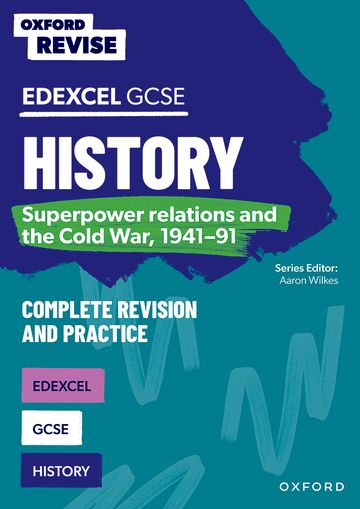
Edexcel GCSE History Superpower Relations and the Cold War, 1941-91
Learn everything you need to know about the period topic Superpower relations and the Cold War, 1941-91. You will build the knowledge you need to do well in your Edexcel GCSE History exam.
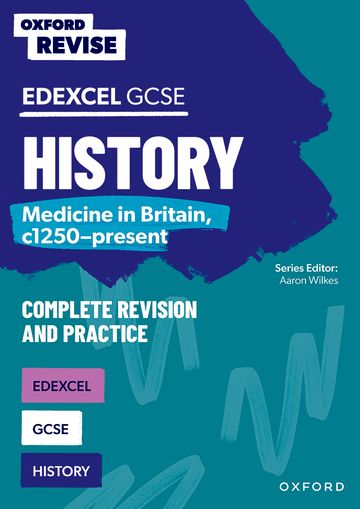
Edexcel GCSE History Medicine in Britain, c1250-present
Learn everything you need to know about Medicine in Britain, c1250-present. You will cover all of the areas of this topic in order to to do well in your Edexcel GCSE History exam.