
How to prepare for your GCSE English Language resits?
Preparing for your GCSE English Language resits can feel daunting – but with the right approach, success is absolutely within reach. Whether you’re aiming to improve your grade or build confidence in key skills, this guide – written by a senior AQA examiner – offers practical, targeted advice to help you focus your efforts where they matter most. From analysing past scripts to mastering high-mark questions and using examiner – approved strategies, you’ll find everything you need to turn your resit into a real opportunity for progress.
Senior examiner from AQA, Graham Elsdon, shares his advice on preparing for GCSE English Language resits
So – you’ve decided to re-sit AQA GCSE English Language….
Smart move on your part. You can do it.
But November is on the horizon already. Time is tight. What should your priorities be?
1. Recall your summer exam script to identify gaps ahead of your GCSE English Language resits
First, you need to diagnose your shortcomings. You might already have an idea what you need to work on, but why not get your summer script back?
Doing this will immediately identify question types and skills you need to brush up on.
So, look back at your mock exams and classwork from Year 11. Ask your former English teacher for their thoughts. Look through your old English book.
Find out, then make it your business to master your weakest areas.
There is no point spending hours practising things you can already do. It’s time wasted.
2. Target specific questions to effectively prepare for your GCSE English Language resits
Focus on perfecting ‘big tariff’ tasks – because these are the questions where the big marks reside.
In English language, 80 marks – half of the 140 marks available – rest on two questions: the Section B Writing tasks in paper 1 and 2. Get these right and you’re on the way to success.
Likewise, Paper 1 Question 4 (20 marks) and Paper 2 Question 4 (16 marks) are usually areas where marks can be picked up.
3. Look at Level 3 in the mark scheme ahead of your GCSE English Language resits
Remember that although you receive an overall Level in the 1-9 range, examiners mark each question in a mark scheme consisting of four levels.
As a rough rule of thumb, Level 3 in the mark scheme – where you answer has CLEAR qualities – is your friend.
A ‘clear’ answer means you are:
- clearly answering the question and its bullet points.
- developing your points/ideas rather than letting them die.
- making sure your phrasing makes clear sense.
The student who gets an overall Level 5 in the 1-9 scale (I’m guessing this is your aim) is the one who consistently develops clear answers.
This is why teachers write comments like ‘say a bit more please’ or ‘can you develop this?’ in students’ books. It’s because doing so helps you over the line into the ‘clear’ part of the mark scheme. It’s where you demonstrate deeper thinking.
So, force yourself to ‘say a bit more’, and explain and develop those points in detail.
Write consistently ‘clear’ answers and you will succeed.
4. Get accurate advice to support your GCSE English Language resits
There’s plenty of advice available about English exams. But you need to be certain you’re getting the right guidance.
Anyone can make a YouTube video or give their tips on TikTok. Sometimes, helpful things are said. However, often, the advice contradicts what exam boards tell you they want.
What examiners are looking for is no secret. Their advice comes out every year in the form of an examiner’s report. It’s not as visually exciting as TikTok, but it’s direct from the people who write and mark papers. Read it.
Seek out textbooks matched to the exam-board such as AQA GCSE Oxford Revise English Language. These books are written by senior examiners and the advice in them is consistent with the exam board.
5. Use practice papers when preparing for your GCSE English Language resits
You will have seen several past papers in recent years, but there’ll be plenty you haven’t used. You’ll find them here.
Work through these papers. Target those question types you know you need to master.
Don’t just read them and imagine what you’d write. Do them. Practice helps.
6. Read good answers and use them to inform your GCSE English Language resits
The chances are that last year, your teacher provided you with examples of good answers. These are gold dust.
Hunt out those examples. Ask your old English teacher for some. You’ll see some here too. You’ll also find some in the GCSE Revise book mentioned above, alongside new practice papers.
Look carefully at the way these good responses gain marks. Don’t casually read them. Unpick why they succeed. You’ll find they do exactly the things that the examiner’s report says make good answers.
7. Have confidence when taking your GCSE English Language resits
Remember that not everybody gets things right first time. It’s a fact of life. But have faith – time and practice help. Don’t give up.
The Paper 1 resit takes place on 4th November.
Paper 2 is on 6th November.
Year after year, students succeed in these resits.
Make yourself one of these students.
Graham Elsdon is author of Oxford Revise AQA GCSE English Language and has extensive senior experience with leading national and international exam boards. He is both Chief and Lead Examiner for AQA and has co-designed some of the current English specifications. He delivers staff CPD, student masterclasses and is a visiting lecturer at Newcastle University. Graham has authored several English textbooks for OUP and CUP. For 24 years, he was an English leader in a state school in England.
Found Graham Elsdon revision tips and exam strategies useful? Watch more from Graham Elsdon on the Oxford Revise YouTube Channel.
Useful links
Subject-specific resits
GCSE English Revision Guides
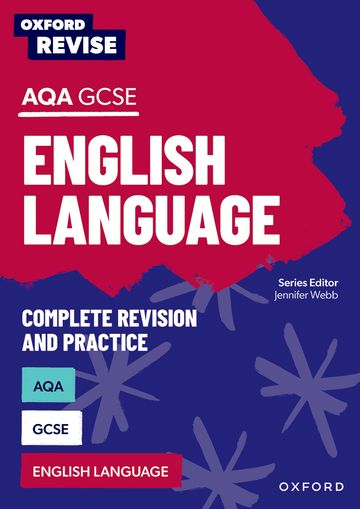
AQA GCSE English Language
This revision guide gives you all the key information you need to revise and prepare for your AQA GCSE English Language exam using a 3-step approach.