
Your eDEXCEL a lEVEL gEOGRAPHY Exam Explained with David alcock
Preparing for your Edexcel A Level Geography exam can feel overwhelming, especially with the depth of content you need to master. That’s why David Alcock – one of our expert authors at Oxford Revise – is here to help. He breaks down the A Level Geography exam and specification and clearly explains what to expect in your exams, so you can revise with confidence and focus.
Your Edexcel A Level Geography Exam explained
Hello, I’m one of the OUP revision guide authors, and I’m here to walk you through the Edexcel Geography specification.
There are four units in total. Unit 1 focuses on Physical Geography, Unit 2 covers Human Geography, Unit 3 is a Synoptic Paper, and Unit 4 is the Independent Investigation, sometimes referred to as the NEA.
Get to grips with your Edexcel A Level Geography Exam – Unit 1: Physical Geography
To begin with, Unit 1, Physical Geography, is assessed through a two-and-a-quarter-hour exam. In this paper, you’ll face a range of short and extended response questions, including 12-mark assess questions and 20-mark evaluate questions.
When tackling the 20 mark evaluate questions, it’s important to set out a clear argument. To strengthen your response, balance your points by exploring multiple sides of the issue, support your ideas with relevant case study evidence, and finally, draw a well-reasoned conclusion.
The topics in paper one. Well there’s some compulsory elements. There’s tectonics and water. And then the optional elements are coastal and glaciated landscapes.
Tackle your Edexcel A Level Geography Exam – Unit 2: Human Geography
Paper Two is the Human Geography paper. Like Paper One, it’s a two-and-a-quarter-hour exam. You’ll see a similar range of question types, so focus your revision on the 12 mark assess questions and the 20 mark evaluate questions.
The compulsory topics include Globalisation and Superpowers. Then, depending on your options, you’ll study either Regenerating Places or Diverse Places, and either Health, Human Rights and Intervention or Migration, Identity and Sovereignty.
Across both Paper One and Paper Two, you’ll also be tested on skills-based questions. These cover mathematical, graphical and statistical techniques. You can find the full list in your specification – so make sure you check it and practise regularly.
Delve into your Edexcel A Level Geography Exam – Unit 3: Synoptic Paper
Paper 3 is the Synoptic Paper. In this exam, you’ll be given a resource booklet – usually based on one region of the world. To begin with, spend 10 to 15 minutes working through the booklet before answering any questions.
The questions will draw partly on your own knowledge and partly on the information in the booklet. These build up to 18 and 24 mark evaluate questions.
To tackle these effectively, set out a clear argument. Then, balance your points by considering different perspectives. Support your ideas with case study evidence from your course, and importantly, include relevant details from the booklet.
Like the other papers, this is a two-and-a-quarter-hour exam, so time management is key.
How are the Geography exams assessed?
The marks are split across four units. Paper One and Paper Two each count for 30%, whilst Paper Three makes up 20%. The final 20% comes from Unit Four – the non-examined assessment, also known as the NEA or Independent Investigation.
This is a 3,000-4,000 word project based on primary and secondary research. You’ll choose a topic linked to the specification, and your teacher will assess it. It’s then externally moderated.
Overall, this specification offers a modern take on key geography themes – many of which you may have studied before and could explore further at university.
It prepares you not only for academic study but also for a wide range of careers where geographical skills are highly valued. We hope the Oxford Revise guide, packed with past paper questions, helps you succeed in your A Level studies. Good luck!
Would you like more support with your Geography revision?
For even more A Level Geography support, read David’s simple guide on how to revise effectively for your exams. With clear and accessible, manageable revision tactics that genuinely work, it’s a great next step in your revision journey!
Found David Alcock’s A Level Geography revision tips and exam strategies useful? Watch more from David Alcock on the Oxford Revise YouTube Channel.
Useful links
Geography revision
Revision books
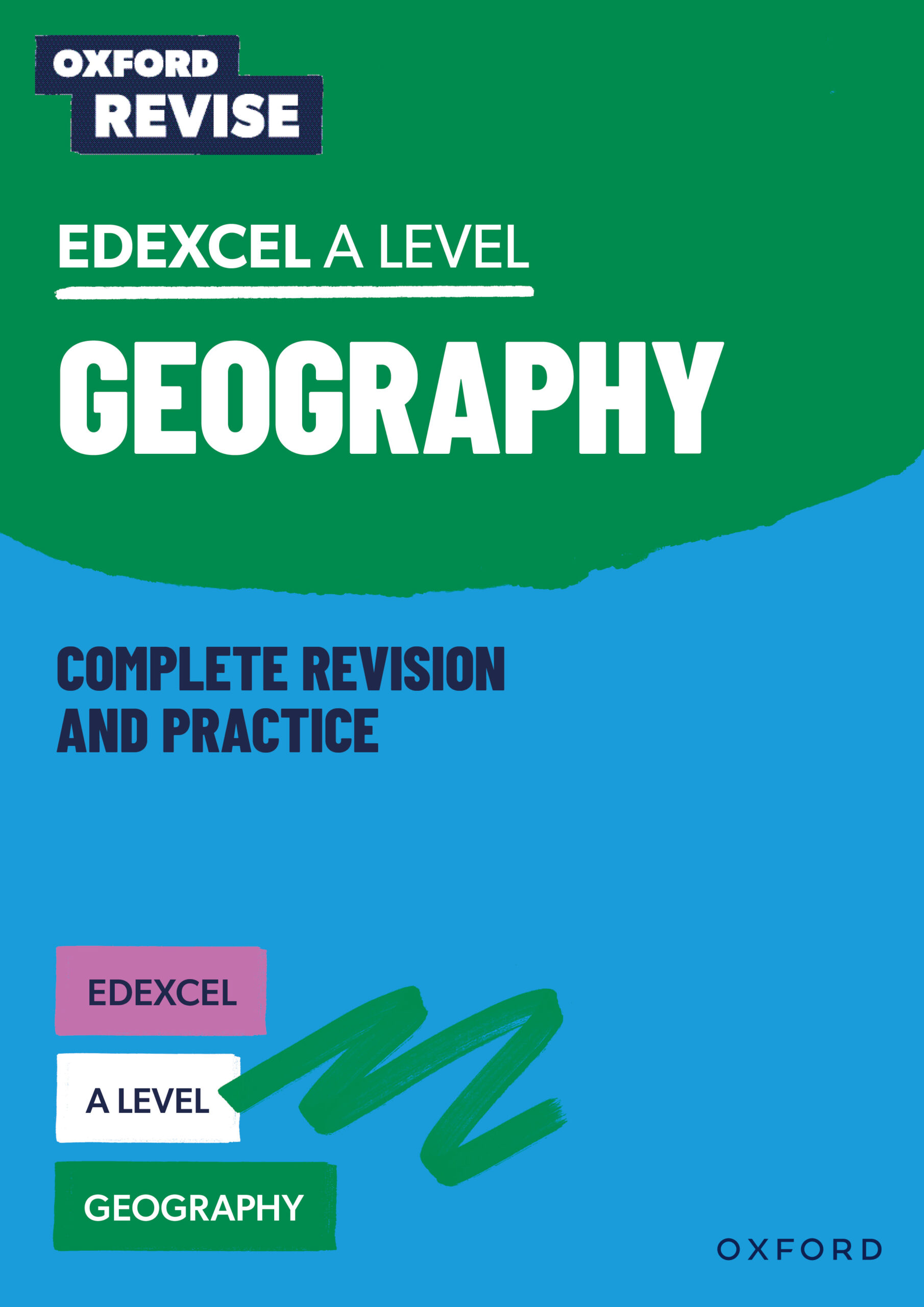
Edexcel A Level Geography
This revision guide gives you all the essential information you need to succeed in your Edexcel A Level Geography exams. You’ll actively explore key topics – including water and carbon cycles, globalisation, and geographical skills – whilst building the knowledge and confidence to tackle every paper.