
starting secondary school
New uniforms, new routes, new rules, new friends.
Starting secondary school can feel very overwhelming for children and adults alike! From the hours of the school day, to the apps they use to communicate with families, there is a lot of change involved in the transition to secondary school.
The Oxford Revise team have put together some guidance and tips to help you prepare and plan before and after the start of term.
Useful links
Travelling To School By Themselves
Depending on their primary school, this may be the first time that your child has to get themselves to school. They may find this fun or be a bit daunted by the task.
If they are going to travel to school on their own or with friends, you may want to:
- Have several trial runs of the journey. Each trip will gradually build their confidence.
- Practice runs will also help with timings, so they know when they need to leave the house. If they are travelling with friends, it may be helpful to allow some extra time, as their pace may slow down as their talking!
- If they’re taking the bus, make sure they know their route number, which stop to get off at, and any alternative routes.
- Give them emergency phone numbers to keep in their bag in case they lose their phone and need to contact you.
Building Confidence and Making Friends
Whether they’re moving to secondary school with a group of primary school friends, or on their own, they’ll be joining tutor groups with lots of new faces, and it may feel like they’re starting again when it comes to friendships.
- It’s important to remember that friendships take time to develop, so don’t panic if they haven’t made a close friend straight away. Friendship groups are often quite fluid during the first few weeks, and even years, of secondary school.
- Remind your child that everyone is starting from the same place. Small steps, even those that take them outside of their comfort zone, should be encouraged to help buil their confidence. If they find it difficult to start conversations, you could discuss some simple openers.
- Encourage them to join clubs and become involved in school life. This can be a good way to make friends with students in other forms and year groups.
Getting Organised
Hopefully transition days organised by the secondary school at the end of Year 6 will have given them an idea of what to expect for the first few days. Some schools may have a day or two of just Year 7s on site, to help them navigate the new environment and rhythms of the day.
- Put their timetable in a shared space like a fridge or by the front door, and have a copy that they have on them – in a pocket or school bag.
- It can be helpful for the first couple of weeks (or terms!) to ask them what they have the next day so that they can get into the habit of making sure their bag is ready. Don’t be tempted to pack their bag for them!
- There are a number of parent-facing apps used by schools, so make sure that you havve downloaded or bookmarked the right ones and can access them.
- If your child has a mobile phone, it’s important that everyone understands the school’s policy and expectations regarding phone usage on site.
Homework
Homework is one of those adjustments that can catch children by surprise. Just when it seems as though they are settling into their new routine, homework can start to arrive more regulary, and feelings of overwhelm may return. In the early stages, you may need to provide more supprt to help them develop the habit of regularly checking what work is due and when it needs to be completed.
- More schools use something like Google classroom to assign homework. Explore the site together so that you are all familiar with the features.
- Help them to distinguish between tasks that are best staggered over time (revision, research, etc) and self-contained tasks that can be done and then ticked off.
- If homework is taking longer than expected, don’t worry. Talk to them about what they’re working on. It may be that they’ve found something particularly interesting and want to do a thorough job. They may be misunderstanding the level of detail required, or finding something hard. If this happens, encourage them to speak to their subject teacher as early as possible.
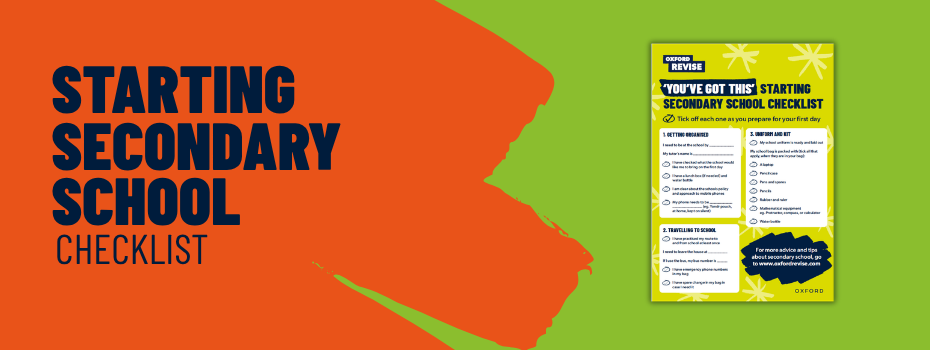
The Starting Secondary School Checklist
For your peace-of-mind, download the checklist and start ticking it off together! You’ll feel so much more in control seeing the list of things to do get smaller.
“I’d been under the impression that I wouldn’t hear as much from a secondary school compared to primary, but that hasn’t proven to be the case! Thanks to the app and regular school newsletters, I now have more idea as to what my child is doing each week than before.
“Starting secondary school is such a milestone event! It’s a point where you might start having more conversations about increased independence. We found that we had to discuss, manage and then re-evaluate situations regularly to make sure that everyone was happy!
English Curriculum
- Read widely and in depth: Literature plays a vital role in children’s cultural, emotional, and intellectual development.
- Acquire a wide vocabulary and an understanding of grammar and linguistic conventions for reading, writing, and spoken language.
- Write clearly and accurately and adapt their written style for a range of contexts and audiences.
- Explain their understanding and ideas verbally, and participate in group discussions.
Science Curriculum
- See the connections between Biology, Chemistry, and Physics, and the big ideas underpinning scientific knowledge and understanding.
- Relate scientific explanations and phenomena to real-life examples and the world around them.
- Learn to ‘work scientifically’ with a focus on critical thinking and data literacy e.g. collecting, processing, and recording data to evaluate results, and taking account of new evidence and ideas.
Maths Curriculum
- Study topics such as number (percentages, fractions, and decimals), algebra, ratio, geometry, proportion, and statistics.
- Develop fluency, mathematical reasoning and competence in solving increasingly sophisticated mathematical problems.
- Begin applying mathematical knowledge in other subjects, such as Science, Geography, and Computing.
Modern Foreign Languages Curriculum
- Pupils must learn at least one modern foreign language, though schools can choose which they teach.
- Lessons should develop pupils’ confidence in listening, speaking, reading and writing, based on core grammar and vocabulary.
- Pupils should be able to understand and communicate personal and factual information as well as points of view.
The Starting Secondary School Guide
This guide supports some of the key areas of concern that families face during this period of change. From planning the new route to school, to making friends, and understanding what goes on in each subject – we’ve got you covered!